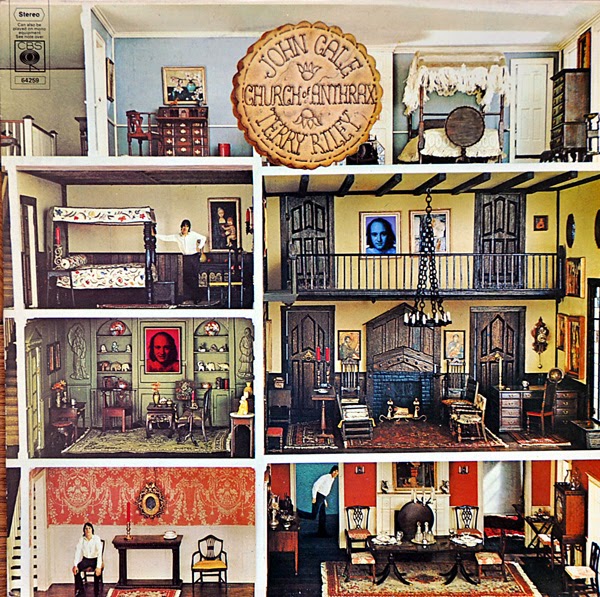
John Cale returns from Velvet Underground to his avant garde background joining up with arch minimalist Terry Riley ... Early 'rock-based' minimalism group ...
This album marks a cross-pollination. Cale may have been returning to
his Minimalist roots, but he still had the sound of VU’s white noise
ringing in his ears and as a consequence managed to produce a
brilliantly messy, repetitious rock record. Early Minimalism had much in
common with rock anyway: the ensembles which Philip Glass and Steve
Reich were establishing, as well as the previously-mentioned Theatre Of
Eternal Music, resembled rock groups as much as they did traditional
classical ensembles... headheritage.co.uk ...
This album is a fantastically raw piece of music which is unlike any of
Cale’s other solo albums. It also has an strange ancient-ness to it
comparable to Amon Düül II’s ‘Phallus Dei’. The combination of its
general lack of conventional song structure and its street-suss edge
makes it rank alongside much of what was being produced in Germany at
the time, in that it was pushing the limits of rock music’s sound in a
similar direction. Cale’s comment that “‘Anthrax’ is just an improvised
gig with Terry” shows that he himself may not have regarded it as a
particularly important album. However, it stands up as an inspired
exercise in minimalist rock music... headheritage
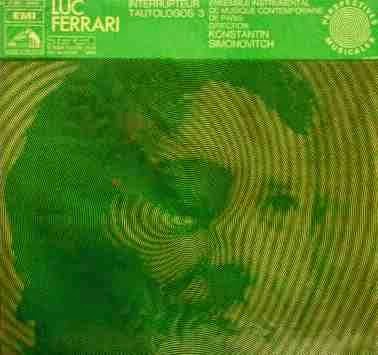
Ferrari has time and again ranged far afield of musique concrète, and
Interrupteur/Tautologos 3 is one such foray into instrumental music.
These particular realizations came about through Ferrari's directed
improvisations of Konstantin Simonovitch's ensemble, and the recordings
were originally released in 1970 by EMI in their 'Perspectives
Musicales' series. 'Interrupteur' is largely static music, a music of
long tones periodically interrupted by aleatoric events. If it
references musical minimalism (particularly Terry Riley, Steve Reich,
and Robert Ashley), this surely counts as an intuitive, very personal
result.
Tautologos 3 (Part 5) ...
'Tautologos 3' pursues the idea of the superposition of cycles of
different lengths that, once set into motion, will continually result in
new events.
'Interrupteur' is from 1967 and features the following
instrumentation: English horn, clarinet, bass clarinet, French horn,
trumpet, violin, viola, cello, two percussions, two electric organs. It
is one of the most outright powerful and devastating recordings within
the avant garde realm. "Tautologos 3" is from 1970 and features: flute,
oboe, clarinet, trumpet, trombone, viola, cello, double bass, electric
guitar, electric organ & vibraphone... boomkat.com ...
"Tautologos 3" from 1970 is going to be reissued by David Grubbs. Is he going to re-record the piece or use Simonovic's original performance? They're going to reissue the original. Which isn't bad, actually... it's fun. "Tautologos 3" is another story, one which inevitably puts me in line with the American minimalists. I think I already knew their music-around 1970 I went to the States and met Steve Reich, Terry Riley, Robert Ashley, Gordon Mumma... I like these guys a lot. Maybe the idea was already there. When was "In C"? 1964? I couldn't say I was a minimalist at the time, but I was always interested in repetition: I just didn't know how to tackle it. I was tied up in serialism in the 60s, but even so I was experimenting with loops which repeated in cycles which never met up-that was also the idea of the "Music Promenade" installation we talked about: Musical events where you perceive the idea of repetition without them being necessarily repetitive themselves. What interested me was looping the events in such a way that each time they reappeared, they created new musical objects. The idea of tautology. The first "Tautologos 3" was a written score, a text-score (like many others at that time), where I explained the rules of the tautology; it was a score which gave individual players the freedom to choose their action. We did this version a lot, in instrumental and theatrical contexts. Well, what with mixing up other people's instrumental and theatrical actions, after a while I wanted to do my version of the piece! (Laughs) So I wrote an instrumental score which respected the demands of the text-score. From time to time I taught workshops where I did "Tautologos 3" very often, with the students having to follow the score quite closely-so when I showed them my own version they said: "You're cheating! You're not following the rules!" And I said: "I am free, you know..." The other piece on the CD is "Interrupteur". What were you trying to do with in that work? I wanted to write the most static music possible. I suppose it didn't work out, as it's quite a busy score! (Laughs) The idea was to have instrumental continuities which went from beginning to end. One instrument goes up for ten minutes and comes down for ten minutes, while another goes up for three minutes and comes down over the next seventeen, and so on. Each instrument had its plan and there were lines which crossed, and each time that happened there was a special event. That was the basic idea. What interested me was to decide on a duration and to see what each instrument was going to do, in a conceptual way. I'm starting to work with durations again, trying to organise them in a completely aleatoric way interms of the composition; it's all written out, but the compositional information is all generated by chance. I take the duration and use it as a painter would, like a canvas... Interview with Luc Ferrari (doc, Dan Warburton, 1998) ...
Minimalist works by the Lost Jockey Music Collective, a group of British composers in the early 1980s including Andrew Poppy and Orlando Gough ... A self released cassette.
Terry Riley playing solo Yamaha keyboard in just intonation ... recorded 1977, based on a piece commisioned and recorded for Radio Bremen in 1976. Riley performed the work solo on a modified Yamaha YC-45D combo organ tuned in just intonation and augmented with studio digital delay...
Music For Amplified Keyboard Instruments (1981) ...
Minimalist keyboard music... David Borden was a founder of Mother Mallard. This was his first solo album. It showcases two of his Continuing Story of Counterpoint series... Esty Point, Summer 1978 ...
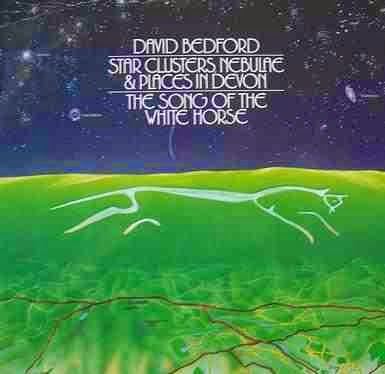
Star Clusters, Nebulae and Places in Devon (1971) ...
David Bedford's choral piece for double choir and brass instruments ...Inspired by the fact that some starlight we see today left the stars thousands of years ago. Two choirs recite separately names of stars and local Devonshire name places ...the 'places' represent the many Bronze Age sites in Devon, and the light from the Great Star Cluster in Hercules left there 3500 years ago...
Choir 1. The Great Nebula in Andromeda The Whirlpool Nebula in Canes Venatici Spiral Nebula in Triangulum Globular Star Cluster in Hydra The Great Lagoon Nebula in Sagittarius Star Cluster in Cassiopeia Star Cluster in Perseus Bode's Nebula in Ursa Mayor The Owl Nebula in Ursa Mayor Nebula in Eridanus The Crab Nebula in Taurus Star Cluster in Auriga Globular Star Cluster in Serpens Ring Nebula in Hydra Great Star Cluster in Hercules The Horseshoe Nebula in Sagittarius The Veil Nebula in Cygnus The Horsehead Nebula in Orion The Coalsack in Cygnus Globular Star Cluster in Pegasus The Keyhole Nebula in Eta Carina The Great Nebula in Orion Choir 2. Cullompton Bovey Tracey (pronounced "Buvvy" Tracey) Starcross Ipplepen Dunchideock Little Hempston Cheriton Bishop Sticklepath Dunnabridge Pound Lustleigh Cleave Newton Poppleford Torcross Chivelstone Mary Tavy Rippon Tor Drizzlecombe Hope's Nose Cater's Beam Hangingstone Hill Penn Moor Black Ridge Murchington Belstone Corner Hollow Moor Black Dog Yes Tor North Radworthy High Willhays